Article Content
Transportation is undergoing a radical shift as urban centers around the world implement stricter emission regulations, congestion pricing, and reduced parking infrastructure. For corporate enterprises, small business owners, and commercial fleets, traditional company cars are fast becoming financial liabilities. In response, forward-thinking organizations are turning to corporate e-bike programs as a high-ROI alternative that solves mobility challenges while dramatically reducing overhead costs.
The Financial Advantage of Corporate E-Bike Fleets
Managing a traditional fleet of motorized vehicles incurs substantial recurring expenses, including skyrocketing fuel costs, comprehensive auto insurance premiums, parking space leases, and routine mechanical maintenance. Electric bicycles offer a fraction of these operational costs while providing comparable, if not superior, efficiency for short-to-medium distance urban transit.
- Negligible Fuel and Charging Expenses: Charging a fleet of lithium-ion e-bike batteries costs mere cents per vehicle, shielding businesses from volatile fuel prices.
- Drastic Insurance Reductions: Commercial e-bike insurance policies carry significantly lower premiums compared to commercial auto policies.
- Tax Incentives and Subsidies: Governments across North America and Europe offer lucrative tax write-offs, green energy subsidies, and corporate sustainability grants for businesses adopting zero-emission fleets.
Boosting Employee Retention and Daily Productivity
Beyond direct financial savings, corporate e-bike lease programs have emerged as a powerful tool for talent acquisition and employee well-being. Modern professionals prioritize companies that demonstrate genuine commitment to environmental sustainability and employee health.
By providing subsidized e-bikes for daily commuting, companies enable employees to bypass traffic jams and eliminate the stress of urban parking. Studies show that active commuting increases focus, reduces sick leave, and improves overall workplace morale. Employees arrive at the office energized rather than exhausted by heavy traffic.
Selecting the Right E-Bike Fleet Management System
Deploying a successful corporate fleet requires strategic hardware and software integration:
- Commercial-Grade Cargo and Utility E-Bikes: High-torque motors ($500\text{W}$ to $750\text{W}$) paired with dual-battery systems ensure vehicles can carry heavy loads and operate all day without recharging.
- Telematics and Fleet GPS Tracking: Built-in IoT hardware allows operations managers to monitor vehicle location, track battery health, schedule preventative maintenance, and prevent theft in real time.
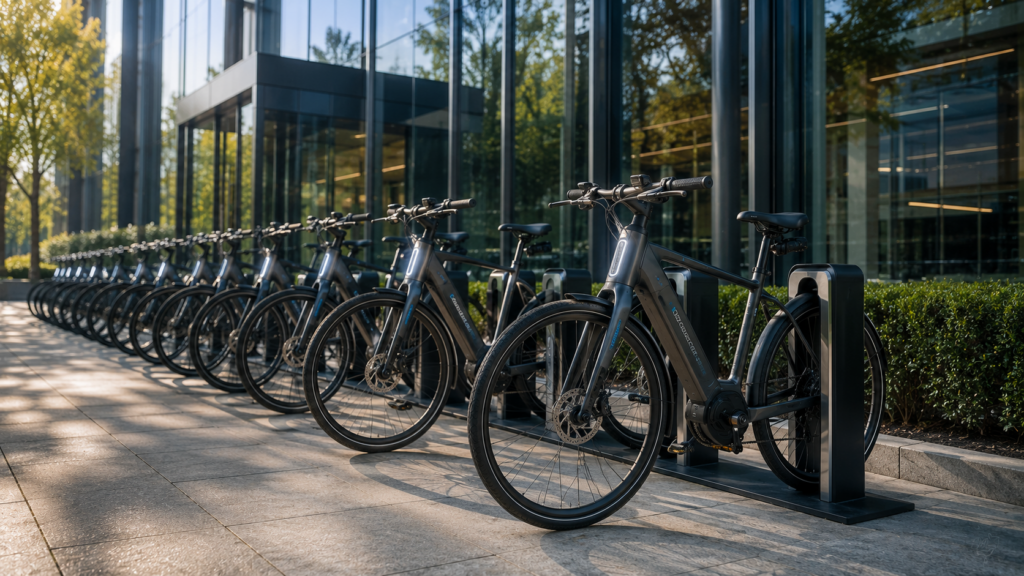
- Smart Lock Infrastructure: Docking stations and digital key-less locking solutions allow seamless sharing among staff members through dedicated smartphone apps.
The Future of Sustainable Urban Logistics
As cities continue to close central districts to gas-powered vehicles, commercial e-bikes are no longer just a trend—they are a critical business asset. Companies that adopt micro-mobility solutions today lock in long-term cost savings, enhance their corporate social responsibility (CSR) standing, and build a more resilient workforce for the future.

Welcome to the The Bicycle Outfitter Inc. We value your questions, suggestions, and feedback.