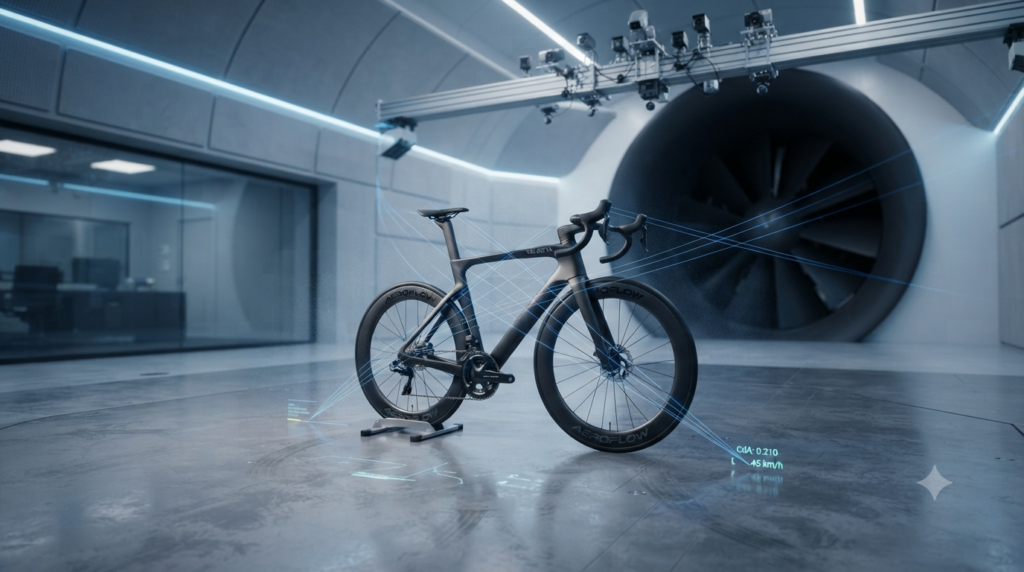
In the competitive world of endurance sports and cycling performance, marginal gains determine the difference between winning and coming in second. Modern high-performance road bikes are no longer mass-produced commodities; they are custom-engineered precision machines built around advanced aerodynamics, specialized carbon fiber layups, and biometric customization. Investing in a custom carbon build represents the pinnacle of cycling engineering, delivering maximum power transfer, reduced fatigue, and optimal aerodynamic efficiency.
The Material Science of Ultra-High-Modulus Carbon Fiber
Not all carbon fiber frames are created equal. High-performance custom builds utilize a strategic blend of intermediate, high-modulus (HM), and ultra-high-modulus (UHM) carbon fibers bonded with resin systems:
- Torsional Stiffness vs. Compliance: Frame engineers position rigid UHM fibers along the bottom bracket and chainstays to ensure every watt of pedaling force converts directly into forward motion. Conversely, more flexible fibers are integrated into the seatstays to absorb high-frequency road vibrations.
- Custom Layup Patterns: Unlike off-the-shelf production bikes manufactured with uniform molds, custom carbon builders tailor the layup schedule to match the rider’s exact body weight, power output, and riding style.
- Integrity and Structural Longevity: Advanced resin matrix systems reinforced with nano-particles increase impact resistance, shielding thin-walled carbon tubes from catastrophic failure during minor impacts.
Aerodynamic Optimization and Computational Fluid Dynamics (CFD)
At speeds exceeding 20 mph (32 km/h), aerodynamic drag accounts for over 80% of the total resistance a cyclist encounters. Designing an aerodynamically efficient road setup requires extensive virtual wind-tunnel testing using Computational Fluid Dynamics (CFD):
- Truncated Airfoil Tube Profiles: Traditional round tubes create massive air turbulence behind them. Modern truncated teardrop profiles channel airflow smoothly around the frame, even during crosswinds.
- Fully Integrated Cockpits: External cables, brake lines, and junction boxes disrupt clean airflow. Fully internal cable routing through the handlebars, stem, and headset reduces drag while providing a ultra-clean aesthetic.
- Deep-Section Carbon Wheelsets: Pairing a custom frame with 50mm to 60mm deep-section carbon rims maximizes aerodynamic sail effects, enabling riders to maintain higher speeds with noticeably less physical exertion.
The Crucial Role of 3D Biomechanical Bike Fitting
The most aerodynamically efficient frame is useless if the rider cannot sustain their position comfortably. Human biology accounts for roughly 80% of total aerodynamic drag, making professional 3D bike fitting the most critical step in custom bike building.
- Dynamic Motion Capture: Utilizing high-speed infrared cameras and 3D motion-tracking sensors, fit specialists measure joint angles, knee tracking, and pelvic rotation in real time while the athlete pedals under load.
- Saddle Pressure Mapping: Pressure-sensitive mats placed on the saddle identify localized friction points and soft-tissue pressure, allowing fitters to select the exact saddle profile and tilt angle required for comfort.
- Power Output Optimization: A professional fit strikes the precise balance between an aggressive aerodynamic posture and maximum oxygen uptake, ensuring sustained power output over long distances without risking strain injuries.
The Ultimate Performance Upgrade
Building a custom carbon road bike is the ultimate convergence of sports science, aerospace engineering, and personalized ergonomics. By combining tailored frame geometry with aerodynamic optimization and precision bike fitting, cyclists unlock unprecedented levels of speed, comfort, and efficiency on the road.

Welcome to the The Bicycle Outfitter Inc. We value your questions, suggestions, and feedback.